Second Wave
In most crises, leaders are judged first by how quickly they respond. Did they issue the statement, restore operations, protect employees, stabilize the immediate threat? These are necessary questions, but they rarely determine whether an organization truly recovers.
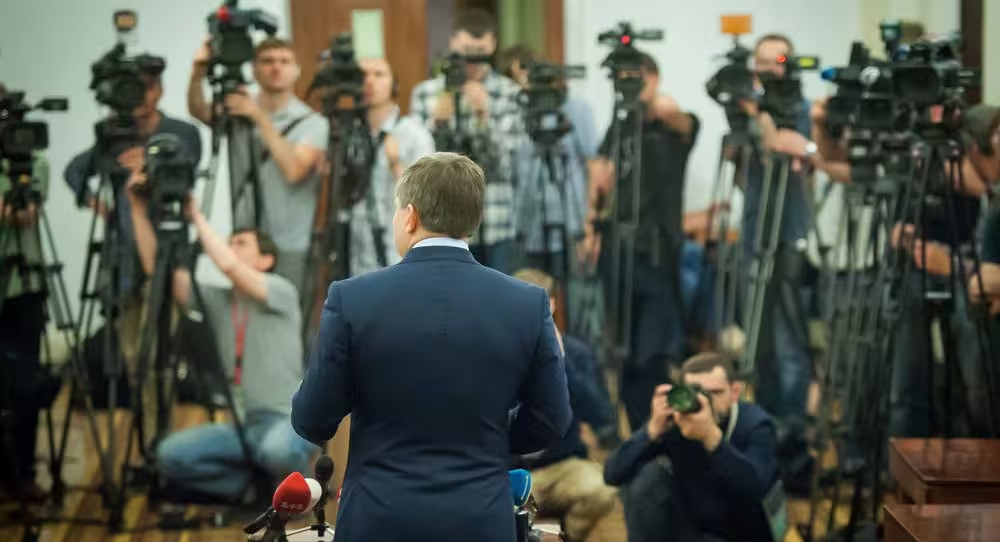
The harder test comes later, after the visible emergency has passed and the cameras, customers, regulators, and employees begin asking a more consequential question: What now?
This is the second wave of crisis. It arrives when the adrenaline fades, when the damage is harder to measure, and when the organization must move from response to repair. In that phase, the challenge is no longer simply containing harm. It is rebuilding confidence, coordinating decisions across fractured groups, and proving that leadership understands the deeper conditions the crisis exposed.
Key Takeaways
- The aftermath is often more complex than the crisis itself. The first wave demands speed and containment. The second wave demands judgment, repair, and credibility.
- Recovery depends on coordination. Employees, customers, regulators, investors, and partners all look for signals that others still believe in the organization. Vague reassurance does not solve this uncertainty.
- Trust is tested after the emergency passes. The aftermath reveals whether people feel safe enough to tell leaders what still is not working. Without psychological safety, organizations can mistake silence for stability.
- Resilience requires specific choices. Real recovery depends on who is included in decision-making, how resources are allocated, and whether leaders address the vulnerabilities the crisis revealed.
- The best crisis plans prepare for the second wave. Organizations should plan not only for response, but also for long-term recovery, stakeholder communication, internal feedback, and accountability.
The Crisis Ends Before the Uncertainty Does
The first wave of a crisis creates urgency. The second wave creates ambiguity. In the immediate response, priorities tend to be clear because the threat is active. Leaders can mobilize around safety, communications, legal exposure, operational continuity, and stakeholder reassurance.
Afterward, the questions become more complicated. Who bears the cost of recovery? Which commitments will be honored first? What will change in the operating model? Who gets included in decisions about rebuilding?
Disaster recovery research makes this point clearly. Post-disaster contexts often force communities to confront long-standing questions about housing, economic opportunity, financing, environmental costs, and decision-making authority. The crisis does not create all of these tensions. It exposes them, concentrates them, and makes them harder to defer.
The same dynamic applies inside organizations. A cyberattack, leadership scandal, workplace safety failure, or public reputational event may begin as a discrete incident, but the aftermath quickly becomes a referendum on the organization’s structure, culture, and credibility.
Recovery Is a Coordination Problem
One reason the aftermath is so difficult is that recovery depends on many people making decisions under uncertainty. Employees decide whether to trust leadership again. Customers decide whether to return. Investors decide whether the company’s explanation is credible. Regulators decide whether corrective action is sufficient. Partners decide whether the relationship still carries reputational risk.
Storr and Haeffele-Balch describe post-disaster recovery as a collective action problem. People are often reluctant to rebuild until they know whether others will return, and delay can make recovery harder as individuals settle into alternative arrangements.
That logic is not limited to neighborhoods after a hurricane. It also describes organizations after a crisis. Employees may wait to see whether leadership’s promises become policy. Middle managers may wait before making commitments to their teams. Customers may wait for evidence that failures were corrected. Silence from one group amplifies hesitation in another.
This is why the second wave punishes vague leadership. General reassurance may calm the first news cycle, but it does not solve the coordination problem. People need visible signals that others are still invested, that decisions are being made, and that the organization has a credible path forward.
What the Aftermath Reveals
During the first wave, hierarchy can carry an organization through. In the second wave, trust matters more. Employees and stakeholders begin to measure whether leaders are willing to hear uncomfortable information, admit unresolved questions, and include the people closest to the damage.
This is where psychological safety becomes more than an internal culture concept. Research on psychological safety emphasizes that organizations lose learning capacity when dissenting views are suppressed, because employees become less likely to raise legitimate concerns, identify risks, or contribute corrective feedback.
After a crisis, that silence is dangerous. The people who understand what broke are often not the people writing the public statement. If they do not feel safe speaking candidly, the organization may mistake compliance for recovery. Leaders may receive polished updates while operational risks remain unresolved.
The second wave becomes harder than the crisis itself because it requires a different kind of leadership discipline. Command-and-control may be useful during immediate containment. Recovery requires listening systems, local knowledge, and mechanisms for dissent that do not punish the people who tell the truth too early.
Rebuilding Must Be More Specific Than “Resilience”
Resilience has become one of the most overused words in crisis management. Too often, it is treated as a personality trait or a branding exercise. In practice, resilience is built through specific choices about inclusion, resource allocation, communication, and accountability.
Gilmore and Standaert argue that post-disaster recovery must be grounded in equity because disasters occur where hazards meet existing vulnerabilities. They note that recovery decisions have long-term consequences for whether communities rebound inclusively or reproduce exclusion.
For companies, the lesson is direct. The aftermath of a crisis should not be managed only by the departments most fluent in risk language. Legal, communications, security, and executive leadership matter, but they cannot be the only voices in the room. Recovery planning should include the employees, customers, suppliers, and local communities most affected by the failure.
A company that treats the aftermath as a liability exercise may reduce exposure while deepening distrust. A company that treats it as an organizational learning process has a better chance of rebuilding legitimacy.
What Leaders Should Do Before the Second Wave Hits
The most effective leaders prepare for the aftermath before the crisis begins. That means building recovery capacity into crisis planning, rather than assuming the job is done once the immediate threat is contained.
A stronger crisis plan should answer several questions in advance: who will gather ground-level information, how dissenting concerns will reach decision-makers, how stakeholder commitments will be tracked, and how leadership will communicate uncertainty without sounding evasive.
It should also distinguish between operational recovery and relational recovery. Systems can be restored faster than trust. A business can reopen, relaunch, or resume service while stakeholders still feel that the deeper issue has not been addressed.
The second wave is where many organizations discover that surviving the event was only the beginning. The real test is whether they can rebuild the conditions that make people willing to stay, return, speak up, and believe the organization has learned enough to deserve another chance.
Disclaimer
This article is for educational purposes only and does not constitute legal, financial, or strategic advisory. Consult appropriate professionals for high-risk or regulatory-sensitive issues.